
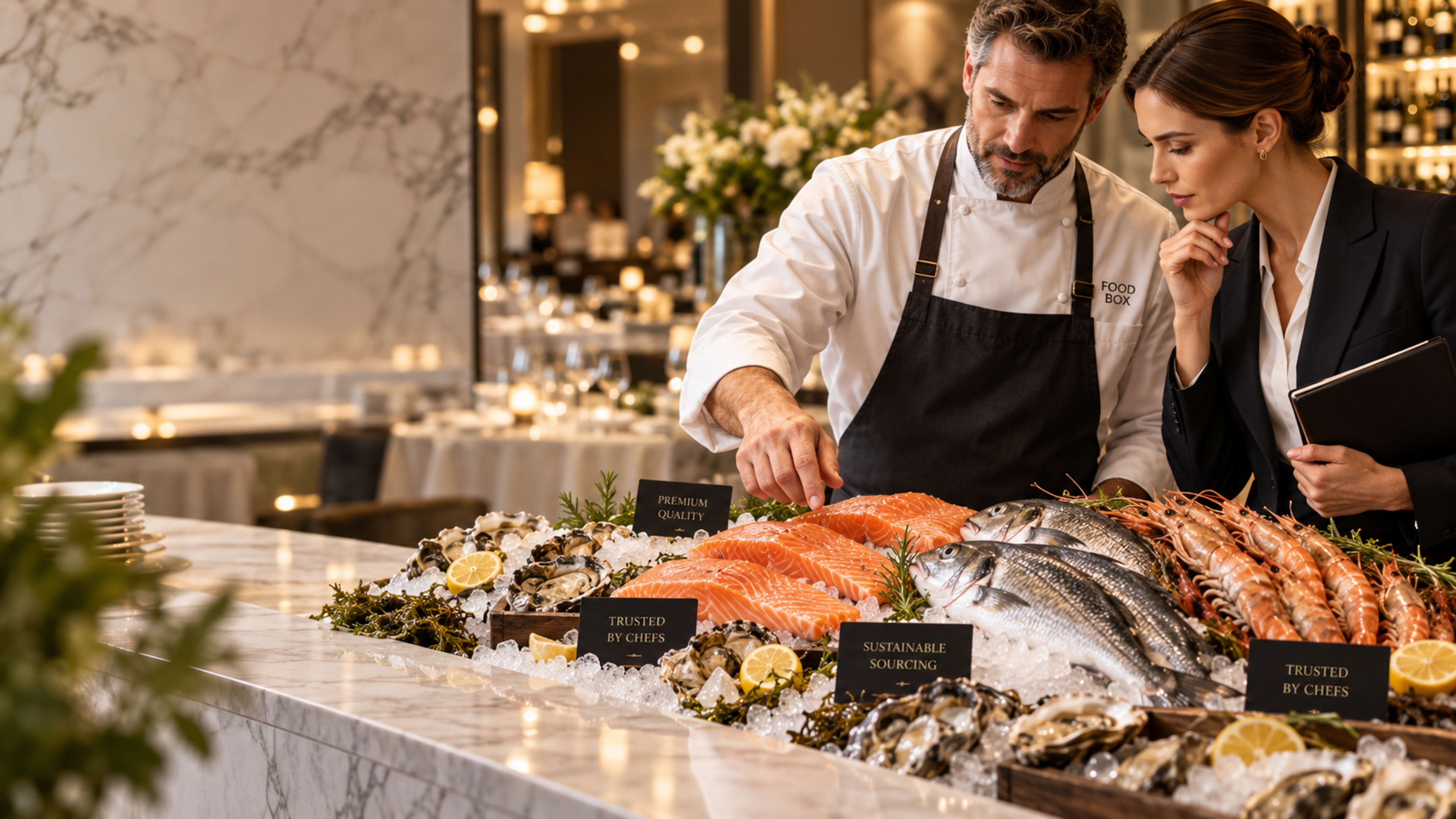
It is the middle of dinner service at a five-star hotel restaurant. The pass is full, the printer will not stop, and the chef de cuisine is calling out plating notes for the third seafood order in ten minutes.
Nobody in that kitchen is thinking about where tonight's shrimp came from, whether the salmon will portion the way it did last week, or whether tomorrow's delivery will arrive on time.
That is exactly the point.
Those questions were already answered, hours or days earlier, by a supplier the kitchen had learned to trust.
This is the real function of a seafood supplier in a professional kitchen: not to deliver one excellent order, but to remove seafood from the list of things a chef has to worry about, delivery after delivery, for months at a time.
Why One Good Delivery Proves Very Little
Almost every seafood supplier can produce one excellent batch.
The harder, and more commercially relevant, question is whether the fortieth delivery matches the first in size, condition, cut, and timing.
For a hotel or restaurant, that question matters more than a single impression of product quality.
A menu is built around a specification: a portion size, expected yield, preparation requirements, and a food-cost model.
When a delivery falls outside that specification, whether through smaller shrimp, inconsistent fillet thickness, unexpected trim, or a product that has not maintained the expected condition through transit, the effect appears immediately in the kitchen's own numbers.
Prep staff spend additional time re-portioning. Usable yield can fall. A dish costed at one margin begins costing something different.
In a more serious case, a menu item may become unavailable for service, leaving the kitchen to solve an operational problem that began much earlier in the supply chain.
This is why procurement teams and F&B directors should evaluate a seafood supplier in the same way they would evaluate any other operational partner.
The question is not simply whether the product is good. It is how much procurement risk and kitchen disruption the relationship removes over time.
What Actually Separates One Supplier from Another
Four areas tend to determine whether a seafood supplier can hold up under real hospitality operations.
Specification Control
Can the supplier repeatedly deliver the agreed size grading, cut, trim, preparation format, and product specification?
Consistency matters because the kitchen has already built its recipe, portioning, preparation process, and food cost around those details.
Delivery Performance
Does the delivery schedule match the way the operation actually works?
Procurement should understand how far in advance an order needs to be placed, which delivery windows are available, and whether those commitments can be maintained during normal service as well as periods of higher demand.
Handling and Product Condition
What happens to the seafood between sourcing and the kitchen?
Storage, handling, transportation, traceability, and the conditions under which the product moves through distribution all influence what eventually reaches the receiving area. This is where the role of a professional seafood distribution company extends beyond simply moving boxes from one location to another.
Distribution Reach
Can the supplier support the actual geography of the business?
A supplier may perform perfectly for one restaurant and still struggle to support a hotel group, resort operation, or catering business working across several destinations.
A supplier that performs well on the first order but cannot sustain these four areas across hundreds of services is unlikely to be the right long-term operational fit.
Consider a mid-size hotel group running the same scallop dish at two properties, one in Cairo and another on the Red Sea coast. A supplier that can deliver the required specification to the Cairo property every morning but cannot support the coastal operation with a workable delivery schedule has not necessarily failed on product quality. The problem is distribution reach and delivery performance.
The group may only discover that difference once both properties are operating at volume and the same menu has to perform consistently across two very different locations. That kind of weakness rarely appears during a single trial order.
Where Food Box Fits into That Standard
Food Box has worked with Egypt's hospitality sector for more than 10 years, supplying seafood to hotels, restaurants, resorts, catering businesses, and other professional hospitality operations.
Its operating standards include HACCP and ISO 22000 food-safety systems alongside Halal certification, giving procurement teams a documented baseline before commercial and operational performance are considered.
Learn more about Food Box and its food-safety standardsDistribution is also structured around the different operating realities of hospitality businesses across Egypt. Food Box's delivery schedule currently includes:
• Cairo and Giza: daily delivery within a morning delivery window.
• Alexandria: three deliveries per week, with 48-hour advance ordering.
• Hurghada and the Red Sea: two deliveries per week, with 72-hour advance ordering.
• Sharm El-Sheikh: two deliveries per week, with 72-hour advance ordering.
• North Coast: daily delivery during the summer season.
View Food Box delivery areas and schedulesFor a hotel group, restaurant, or catering business, a published city-specific schedule gives procurement something valuable: the ability to plan lead times around a known operating model instead of negotiating delivery expectations order by order.
Food Box works with hospitality partners on product specifications, order schedules, and volume requirements rather than treating every professional kitchen as if it needs the same format. That matters when a menu has already been costed around a particular cut, grading, trim, or portion requirement.
Food Box's catering operation supports hospitality events, weddings, corporate functions, seafood stations, buffet service, and other large-scale requirements where product planning has to work across significantly more portions than a typical restaurant order.
Explore Food Box catering and event supplyThe Evaluation That Actually Matters
A trial delivery can tell a chef whether a product looks promising. It cannot tell a hospitality business whether the supplier relationship will still work during the fortieth order, the busiest week of the season, or across several properties operating at the same time.
That evaluation takes longer. It asks whether product specifications remain stable, whether delivery commitments hold, whether the product reaches the kitchen in the expected condition, and whether the supplier can support the operation at the scale and geography the business actually requires.
Before starting a supplier relationship, procurement teams should therefore ask concrete questions:
• What is the exact delivery schedule for our location?
• How much lead time is required for normal, rush, and event orders?
• How are cuts, grades, and other product specifications agreed?
• What happens if a delivery does not match the agreed specification?
• Can the same product requirements be supported consistently across repeated orders or multiple properties?
The quality of the answers matters. A supplier that can give procurement specific operating information is easier to build a kitchen around than one that can only promise “quality products” and “reliable service.”
The strongest seafood supplier relationships are not defined by one impressive delivery. They are defined by how little the kitchen has to think about the supply chain once service begins.
If your hotel, restaurant, or catering operation is evaluating seafood suppliers against that standard, Food Box's team can discuss product specifications, delivery coverage, volumes, and availability for your operation.


