Two kitchens can order salmon from the same supplier and still need completely different products.
One chef may want a salmon side that gives the kitchen control over portion size and presentation. Another may prefer portions that arrive closer to the weight the menu was costed around. A third operation may care less about individual plating and more about reducing preparation during high-volume service.
All three are buying salmon. But they are not buying the same specification.
For professional kitchens, choosing salmon is not simply a question of species, quality, or price per kilogram. The format in which the product arrives affects portioning, usable yield, preparation time, consistency, and the amount of control the kitchen keeps for itself.
The useful question is therefore not only: what salmon are we buying? It is: in what form does the kitchen need that salmon to arrive?
Salmon Is Not One Purchasing Format
“Salmon fillet” can sound specific. For procurement, it often is not specific enough.
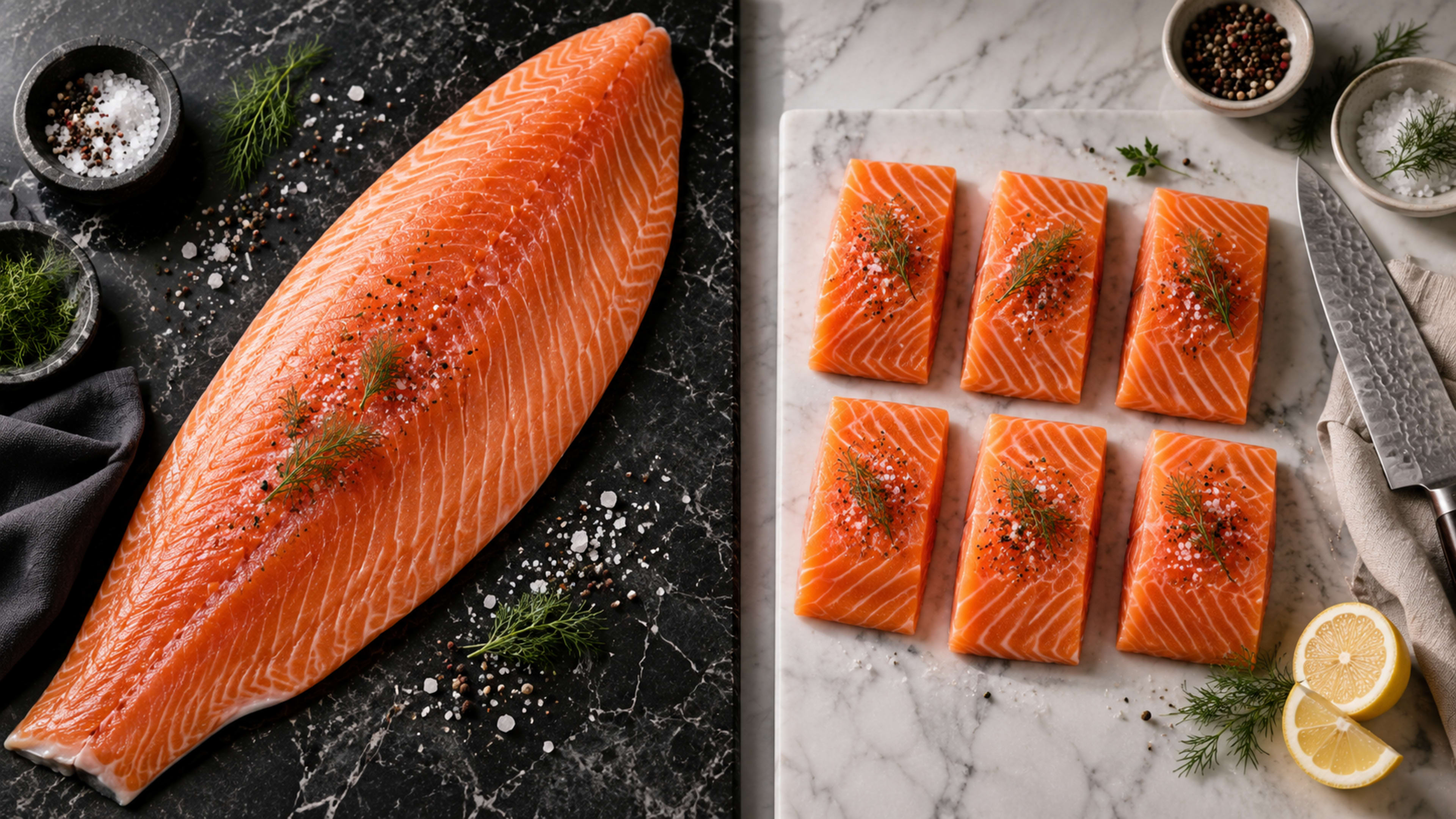
In foodservice, salmon may be supplied in several formats, including a whole fish, a whole fillet or side, and weight-targeted portions. Within those formats, additional details such as skin, pin bones, belly trim, tail trim, and portion range can change what the kitchen actually receives.
Those differences matter because every step completed before delivery is one less step left for the kitchen. At the same time, every additional preparation requirement built into the product can influence its purchase price.
That creates a trade-off professional kitchens need to understand.
A less-prepared salmon format may give the chef more control, but it may also require more skilled labor and produce more trim inside the kitchen. A more prepared format can simplify production and portion control, but the operation needs to decide whether that convenience fits the menu and cost model.
Neither approach is automatically better. The right format depends on what happens after the salmon reaches the property.
A Whole Side Gives the Kitchen More Control
A whole salmon side can make sense when the culinary team wants flexibility over how the product is portioned.
The chef can determine the cut according to the menu, adjust portion sizes for different applications, and potentially use different areas of the side for different preparations.
That flexibility can be valuable in kitchens with the skill, time, and menu structure to use it.
But control also creates responsibility. The kitchen has to manage portioning accurately. Differences in thickness from one area of the side to another have to be considered. Trim needs to be managed. Staff time becomes part of the preparation cost.
If portioning is inconsistent, the advantage of buying a larger format can quickly become a food-cost problem.
A salmon side therefore should not be treated simply as a cheaper or more traditional way to buy salmon. It is a production format. The kitchen needs to know what it intends to do with that flexibility before procurement decides it is the right option.
Portions Trade Flexibility for Predictability
Pre-portioned salmon changes the equation.
Instead of asking the kitchen to turn a larger piece into individual servings, a portion specification can bring the product closer to the form in which it will eventually reach the plate.
For operations built around fixed portion weights, that can make production easier to control. It can reduce the amount of portioning required during prep and make it easier for F&B teams to connect the purchased product to the number of plates expected from an order.
The trade-off is that the kitchen has less freedom to decide how the side will be divided.
That may be completely acceptable in a hotel outlet serving a standardised salmon dish every day. It may be less attractive to a chef using salmon across several preparations that require different cuts.
The question is therefore not whether portions are better than sides. It is whether predictability or flexibility creates more value for this particular operation.
Trim Level Changes What the Kitchen Is Actually Buying
Two salmon sides can look similar on a quotation and still require very different amounts of work before service. The difference can be trim.
Foodservice trim descriptions may distinguish between what has already been removed from the fish, including elements such as backbone, belly bones, fins, belly fat, pin bones, tailpiece, membrane, or skin.
As more preparation is completed before the product reaches the kitchen, the amount of work remaining for the culinary team changes.
That can affect three things immediately:
Labor — How much cutting, pin-bone removal, trimming, or skin preparation remains?
Yield — How much of the purchased weight becomes usable product for the intended dish?
Consistency — How closely can one portion match the next once the kitchen begins production?
This is why procurement should be careful with shorthand descriptions. A trim label is useful only when everyone understands exactly what that trim includes. The specification should describe what will physically arrive, not rely on a name or letter that different teams may interpret differently.
Skin and Pin Bones Are Operational Decisions Too
Details that appear small on a product specification can become important once salmon reaches the prep table.
Skin-on versus skin-off changes both the product and the preparation required for a dish. Pin bones are another example. If the kitchen expects a product with pin bones removed but receives one requiring additional work, the issue is not simply inconvenience. Prep time changes, and the team now has another manual step to complete before service.
Neither skin-on nor skin-off is inherently the better specification. Neither is a particular level of trim. The correct choice depends on how the chef intends to cook, portion, present, and use the product.
The important thing is that those decisions are made before the order is placed, rather than discovered while the kitchen is preparing for service.
The Same Salmon Format Does Not Fit Every Kitchen
A fine dining restaurant may value the flexibility of controlling every cut in-house. A hotel restaurant running a stable à la carte menu may place greater value on predictable portions. A banquet kitchen producing several hundred plates may want to reduce manual portioning before service. A breakfast or buffet operation using salmon in a different application may have an entirely different requirement again.
The product category is still salmon. The operational logic behind buying it changes.
That is why procurement should resist selecting a salmon format simply because it is the one the property has historically purchased. The better starting point is the current menu.
What is the salmon being used for? How many portions are required? What portion tolerance can the dish accept? How much preparation can the kitchen realistically perform? What usable yield does the food-cost model require?
Those questions tell procurement far more than the word “salmon” on a supplier quotation.
Portion Consistency Becomes More Important at Scale
A difference of a few grams may look insignificant on one plate. Across a high-volume operation, repeated variation can become more meaningful.
If portions consistently run heavier than the menu was costed around, ingredient cost moves upward. If they run lighter, the plate may no longer match the chef’s intended standard.
The challenge becomes larger when the same dish is served across several outlets, properties, or event services.
This is why portion specifications often include a weight range or tolerance rather than relying on an approximate visual standard. The objective is not absolute uniformity for its own sake. It is to give the kitchen a predictable operating range it can plan and cost around.
Procurement Should Define the Format, Not Just the Product
A professional salmon order should answer more than: how many kilograms do we need?
Depending on the operation, procurement and the culinary team may also need to define:
• Product format: whole side, portioned format, or another agreed preparation.
• Weight or portion range: what size the kitchen expects to receive.
• Trim requirements: what preparation has already been completed.
• Skin specification: skin-on or skin-off where relevant.
• Bone specification: including the expected pin-bone condition.
• Pack format: how the salmon is packed and supplied.
• Required volume: including changes during events or seasonal demand.
• Intended menu application: where this helps determine the most practical format.
The purpose is not to create a longer purchase order. It is to make sure procurement, the chef, and the supplier are discussing the same product.
Food Box lists salmon as one of the core categories in its professional seafood range and works exclusively with B2B hospitality buyers. Its account managers customise product specifications, order schedules, and volume pricing according to each operation’s requirements.
Explore Food Box seafood solutionsThe Cheapest Format Is Not Automatically the Most Efficient
A whole salmon side and a prepared portion should not be compared on purchase price alone. They leave different amounts of work for the kitchen.
One format may carry a lower price per kilogram but require additional trimming, portioning, skilled labor, and yield management. Another may cost more before it reaches the kitchen but simplify production and make portion cost easier to predict.
The better commercial comparison asks what happens after delivery. How much usable product does the kitchen get? How much labor is required? How predictable are the portions? How closely does the format match the dish the operation actually sells?
Those questions turn salmon purchasing from a commodity comparison into an operational decision.
The Right Salmon Format Begins With the Plate
The best salmon specification works backward from service.
Start with what the guest is meant to receive. Then define the portion, cooking application, presentation standard, production volume, and food-cost requirement behind it.
Only after those questions are clear does the product format become easy to evaluate.
For one operation, the answer may be greater flexibility. For another, it may be tighter portion control. For a third, reducing prep before a large service may matter most.
There is no universal “best” salmon cut for professional kitchens. There is only the format that best supports the menu the kitchen has committed to delivering.
If your hotel, restaurant, or catering operation is reviewing salmon specifications, portion requirements, volumes, or supply schedules, Food Box’s team can discuss product specifications and delivery requirements for your operation.