A chef can order two cases of shrimp at the same weight and get two very different results during service.
One may produce the number of portions the menu was built around. The other may require an additional piece on every plate, change the visual balance of the dish, or produce fewer portions than procurement expected from the order.
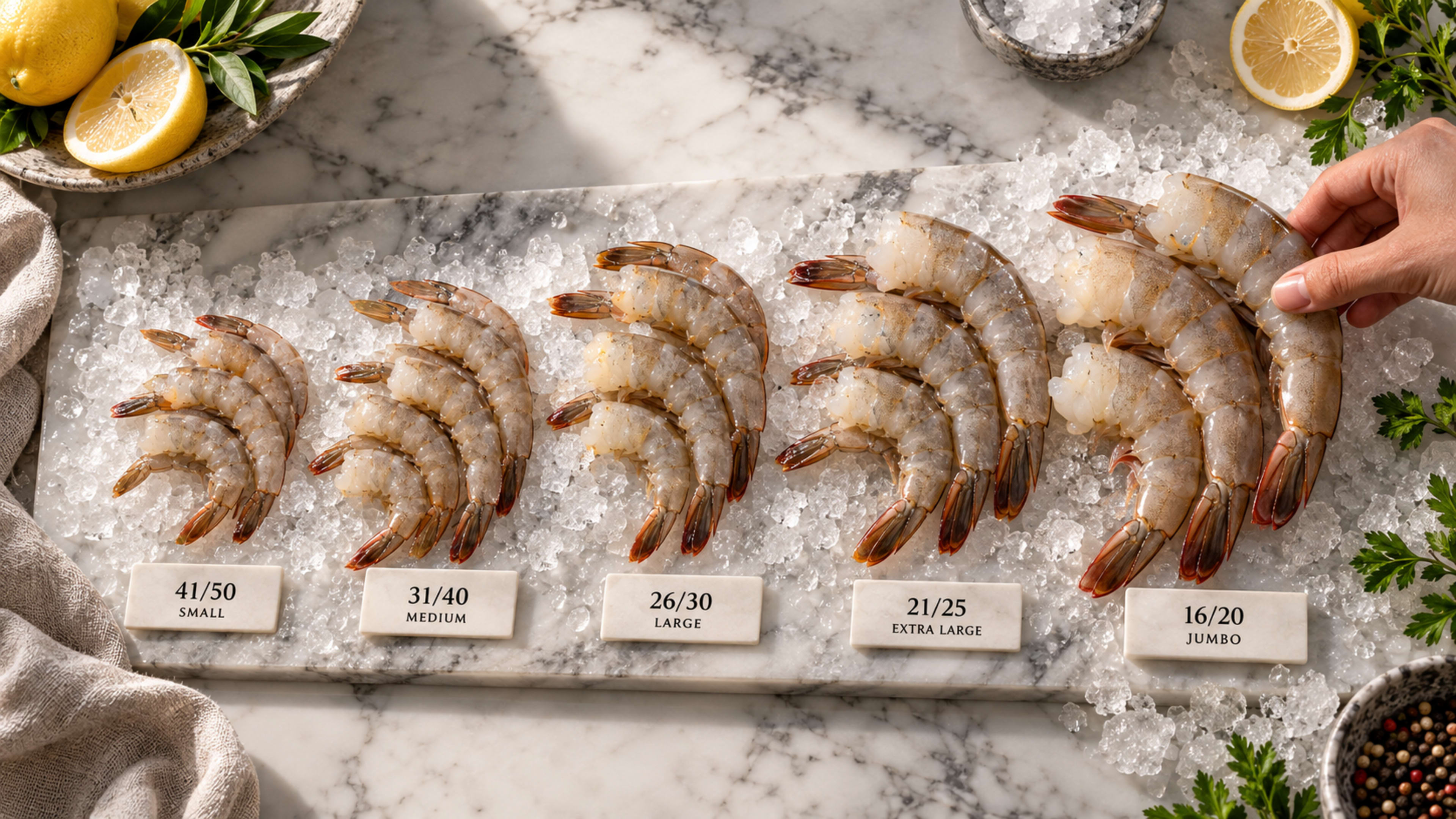
The difference may come down to a number on the specification: 16/20. 21/25. 26/30.
For professional kitchens, those numbers are more than seafood terminology. They influence portion planning, plate cost, preparation, presentation, and the number of servings a kitchen can realistically produce.
Understanding shrimp sizing turns a product description into an operational decision.
The Number Tells You More Than “Large” or “Medium”
Words such as “large,” “jumbo,” or “medium” are useful for general description, but they are not precise enough to build a professional purchasing specification around.
Count sizing gives chefs and procurement teams a more measurable reference.
A designation such as 16/20 generally means approximately 16 to 20 shrimp make up one pound of product. A 21/25 count means approximately 21 to 25 shrimp per pound. When a specification uses U, meaning “under,” a designation such as U/10 means fewer than 10 shrimp per pound.
The principle is straightforward: as the count decreases, the individual shrimp generally become larger.
For a professional kitchen, that distinction matters. The kitchen is not buying “large shrimp” in the abstract. It is buying shrimp for a particular dish, portion, presentation, production volume, and food-cost target.
The count gives the chef and procurement team a common language for defining that requirement.
The Right Count Starts With the Dish
There is no single shrimp count that works best for every menu.
A plated main course may benefit from larger shrimp because each piece has a stronger visual presence. A pasta, risotto, or mixed seafood dish may work better with a different count because shrimp is one component of a larger composition. A buffet may require a size that balances presentation with controlled portions across high volume.
The correct starting point is therefore not the supplier’s price list. It is the dish.
How many pieces should appear on the plate? What portion weight is the recipe built around? Is shrimp the visual focus of the dish or one ingredient among several? How many portions does the kitchen need to produce from the order?
If a plate was designed around four pieces and a change in count means six pieces are now required to achieve the intended portion or presentation, the economics of that dish have changed. That can happen even if the new product looks cheaper on a price-per-kilogram basis.
Shrimp sizing should therefore be decided during menu planning and costing, not after the product reaches the prep table.
Count Size and Portion Cost Belong in the Same Calculation
Shrimp count becomes particularly useful when F&B teams move from purchase price to cost per plate.
Suppose two shrimp specifications are quoted at different prices. Looking only at the kilogram price does not tell the kitchen which option is commercially better. The team also needs to understand how many pieces will be used per portion and how many finished portions the order is likely to produce.
A larger shrimp may cost more per kilogram but require fewer pieces on the plate. A smaller size may appear less expensive but require more pieces to produce the portion or presentation the recipe was designed around.
Neither option is automatically better. The useful question is: what does this specification cost per finished portion?
That connects purchasing directly to the menu. When shrimp count, preparation format, portion requirement, and usable yield are considered together, procurement can compare products on something more meaningful than unit price alone.
Count Is Only One Part of the Specification
A 16/20 label tells procurement something important. It does not tell procurement everything.
The preparation state of the shrimp changes what the kitchen actually receives and how much work remains before service. Shell-on, peeled, peeled and deveined, tail-on, tail-off, and other processing formats can all affect preparation requirements and usable product.
Pack format matters as well. Two shrimp products can carry the same count range while requiring different amounts of kitchen labor or producing different usable results because their processing specifications are not the same.
That is why a professional buyer should read the count alongside the rest of the product specification.
The question is not simply: Is this 16/20 shrimp? It is: what exactly is included in this 16/20 specification?
Count range, preparation state, pack format, and intended use should be considered together before two quotations are treated as directly comparable.
Why Inconsistent Sizing Shows Up During Service
A difference that looks minor during receiving can become much more obvious once production begins.
If shrimp fall outside the size range the kitchen planned around, chefs may have to adjust piece counts, cooking, portioning, or presentation. At low volume, those corrections may be manageable. At hotel, banquet, or catering scale, they become more significant.
A buffet producing hundreds of servings needs predictable portioning. A banqueting kitchen working toward a fixed guest count needs to understand how many servings its inventory can support. A catering operation working within a narrow production window has less room for last-minute adjustments.
This is why consistent grading matters operationally. The purpose of putting a count on a purchase specification is not to make the document look precise. It is to give the kitchen something it can plan around.
Procurement Should Specify the Count, Not the Adjective
A request for “jumbo shrimp” still leaves room for interpretation. An agreed count range removes much of that ambiguity.
For a professional seafood order, procurement and the kitchen should define at least:
• Count range: the agreed shrimp size specification.
• Preparation state: such as shell-on, peeled, deveined, tail-on, tail-off, or another defined format.
• Pack format: how the shrimp will be supplied and in what quantities.
• Required volume: based on expected production and service demand.
• Intended application: where useful, so the chosen specification reflects the way the kitchen plans to use the product.
The purpose is not to make purchasing paperwork longer. It is to make sure the kitchen, procurement team, and supplier are discussing the same product before price and volume decisions are made.
Food Box lists shrimp as one of the core categories in its professional seafood range and works exclusively with B2B buyers including hotels, restaurants, catering companies, and cloud kitchens. Its account managers customise product specifications, ordering schedules, and volume pricing around each partner’s operational needs.
The Same Shrimp Count Does Not Serve Every Operation
A fine dining restaurant, hotel buffet, and catering operation can all purchase shrimp while needing very different specifications.
A fine dining dish may justify a larger size because the shrimp is central to the presentation. A hotel buffet may choose a different count because portion control has to remain practical across hundreds of servings. A catering operation may prioritise predictable grading alongside a preparation format that reduces labor before a fixed event service time.
The product category is the same. The operational requirement is not.
That is why buying the same shrimp size simply because “this is what we normally order” can hide opportunities to improve food cost or kitchen efficiency.
A more useful question is: what shrimp specification best supports this dish, this volume, and this service model? Once those three factors are clear, the count becomes much easier to choose.
A Small Number Can Change the Whole Plate
Shrimp sizing appears to be a small technical detail until the product reaches a working kitchen. Then the count influences portion control, plate cost, preparation, presentation, and purchasing accuracy at the same time.
For the chef, understanding the count helps protect the dish. For F&B, it makes menu costing more predictable. For procurement, it allows supplier quotations to be compared against a defined product instead of a broad description such as “large” or “jumbo.”
That is why 16/20 is not simply a number printed on a seafood case. It is part of the commercial and operational specification behind the plate.
If your hotel, restaurant, or catering operation is reviewing shrimp grades, preparation formats, volumes, or supply requirements, Food Box’s team can discuss product specifications and delivery requirements for your operation.