A seafood delivery can leave the supplier in exactly the condition the kitchen asked for and still lose value before service begins.
The specification can be right. The product can arrive in the expected format. The delivery can be on schedule.
Then the handoff happens.
The order moves through receiving, storage, preparation, and eventually service. From that moment on, the kitchen becomes part of the same quality chain that began long before the product reached the property.
For professional hospitality operations, delivery is not the end of seafood quality control. It is where the next stage begins.
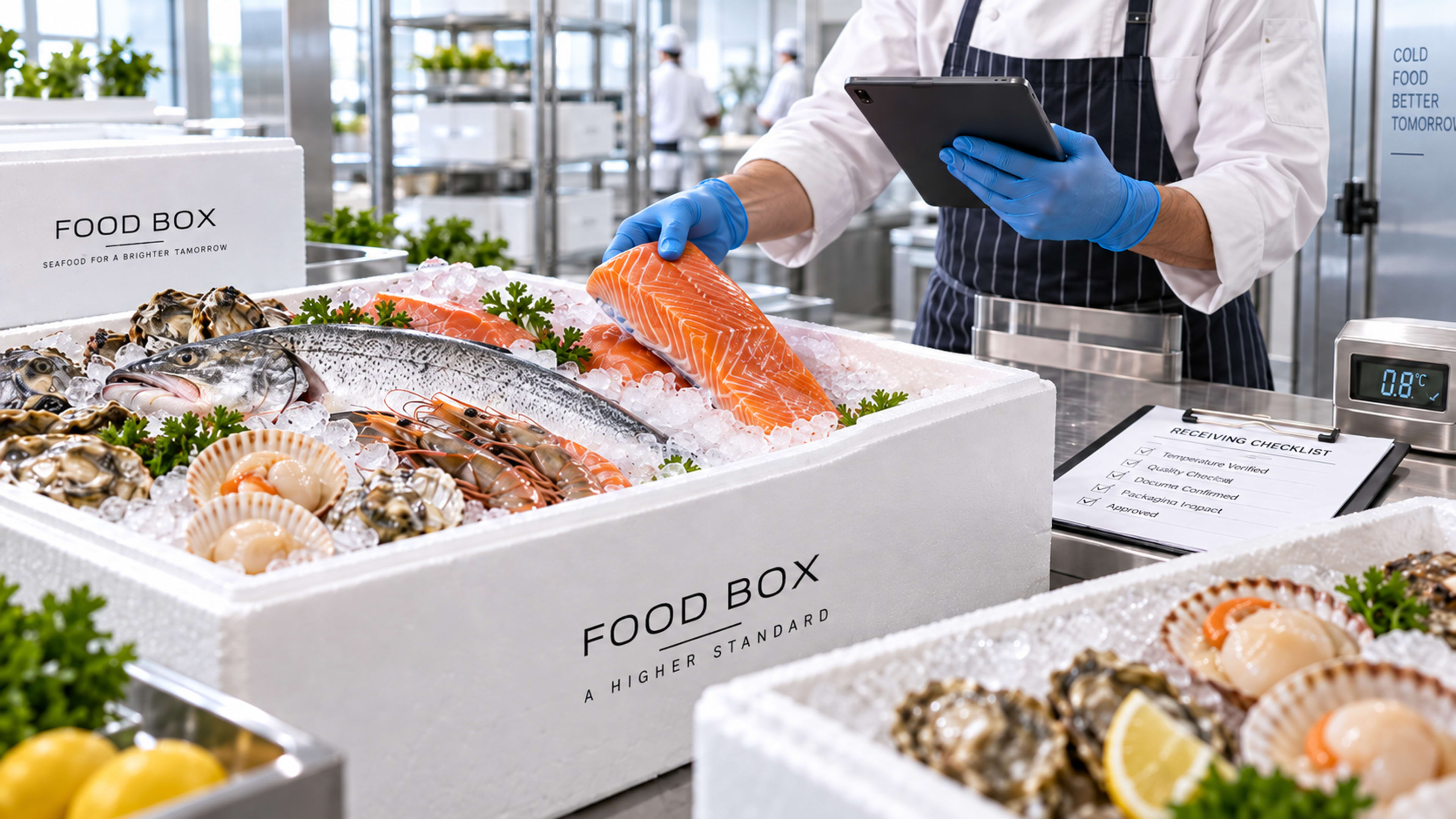
Receiving Is More Than Counting Boxes
A busy receiving area can make seafood look like any other delivery. It is not.
The first task is obviously to confirm that the order and quantity are correct. But professional receiving goes further.
The kitchen needs to confirm that the product arriving is the product procurement and the supplier agreed on beforehand.
• Does the grading match the specification?
• Is the preparation format correct?
• Is the packaging in acceptable condition?
• Has the order arrived within the expected delivery window?
• Is the product in the condition the kitchen expected to receive?
Those checks matter because receiving is the point where an agreed specification becomes a physical product inside the operation. A specification has limited value if the receiving team does not know what it is checking against.
Receiving should therefore be a verification step, not the first time the kitchen discovers what was actually purchased.
The Handoff Should Preserve the Product Identity
A kitchen can spend considerable time defining the right seafood specification and still lose some of that control after delivery. The reason is simple: the product may pass through several people before it reaches the chef who finally uses it.
Receiving accepts it. Stores move it into inventory. Prep teams withdraw it for production. Different outlets may use the same seafood category for different menu applications.
As the operation becomes more complex, maintaining product identity becomes more important.
Clear identification, organised storage, stock rotation, and communication between procurement, stores, and kitchen teams help ensure that an agreed product does not become just another unidentified case in inventory.
That matters particularly in hotels and larger hospitality operations, where salmon, shrimp, lobster, or scallops may be intended for more than one outlet or service format at the same time.
Storage Protects More Than Shelf Life
Storage is usually discussed as a food-safety issue. It is also a product-performance issue.
A seafood product may arrive in exactly the expected condition and still become harder for the kitchen to use if it is poorly identified, unnecessarily handled, incorrectly rotated, or stored without following its documented requirements.
For a professional kitchen, the goal is not simply to hold seafood until it is required. It is to preserve the characteristics the operation purchased it for.
Food Box states that its products are handled under HACCP and ISO 22000 certified conditions, with full traceability from source to kitchen, alongside Halal certification.
Learn more about Food Box’s quality standardsThose systems cover the supply side of the journey. Once the delivery is accepted, the property’s own receiving, storage, stock-management, and preparation procedures become the next link in maintaining the product standard.
Preparation Can Change the Economics of the Product
What happens between storage and the prep station also affects food cost.
A seafood product selected for a particular yield, grading, or portion format should reach preparation in a condition that allows the kitchen to use those characteristics.
If internal handling creates avoidable damage, unnecessary trimming, or inconsistent portions, the operation begins giving up some of the value it paid for.
The supplier may have delivered the agreed product, but the kitchen still has to convert that product into sellable portions efficiently.
That is why procurement, stores, and culinary teams cannot treat seafood as three separate responsibilities. They are working with the same ingredient and, ultimately, the same food-cost model.
The commercial value of seafood is protected only when the product continues to perform through every stage between receiving and service.
Thawing Should Be Planned, Not Improvised
For frozen seafood, thawing is part of production planning. It should not become a last-minute reaction to demand.
A kitchen that understands expected covers, reservations, banquet numbers, menu requirements, and portion needs can plan product movement in advance according to the property’s food-safety procedures and the handling instructions for the specific product.
That planning has an operational benefit as well. Too little product prepared for service creates pressure during the shift. Too much product moved into production can create unnecessary waste or complicate inventory control.
The objective is to connect purchasing, stock management, and prep planning so the amount moving through the kitchen reflects what the operation realistically expects to use.
That becomes particularly important in hotels, banqueting, and catering, where demand can move significantly between an ordinary service and a major event.
Traceability Matters Most When Something Changes
Most deliveries will move through receiving, storage, preparation, and service without creating a problem. The value of traceability becomes clearest when something does change.
If a seafood product does not perform as expected, the operation should be able to work backward.
• What product was received?
• When did it arrive?
• What specification was ordered?
• Which delivery did it come from?
• Where was it stored?
• Where in the process did the difference first become noticeable?
Without that information, a quality concern becomes difficult to diagnose. Was the product outside the agreed specification? Was the wrong product allocated to the dish? Did something change during internal handling? Was the issue limited to one delivery, or does it point to a repeated pattern?
Traceability allows the kitchen and supplier to discuss a specific issue rather than a vague complaint about “quality.” That makes investigation and corrective action more useful for both sides.
Food Box states that its supply process maintains traceability from source to kitchen under its certified handling conditions. The property’s own records then determine how clearly that trail can continue after receiving.
High-Volume Kitchens Need a Repeatable Receiving Routine
The larger the operation, the less practical it becomes to depend on individual memory. An experienced chef may immediately recognise whether a particular salmon or scallop format looks right. A hotel receiving products across several outlets and departments cannot build its control system around one person’s judgment.
The process needs to be repeatable. The receiving team should understand:
• What product was ordered
• What specification it should match
• What condition is expected at receiving
• Where the product should move next
• What should happen if the delivery does not match what was agreed
The aim is not to turn receiving into a complicated inspection exercise. It is to make sure obvious discrepancies are identified before the product disappears into inventory and becomes more difficult to trace.
This becomes even more important when deliveries follow a regular operating rhythm. Food Box currently supplies more than 200 hospitality partners in Egypt and operates scheduled routes across Cairo and Giza, Alexandria, Hurghada and the Red Sea, Sharm El-Sheikh, and the North Coast during summer.
For kitchens working around repeated supply schedules, an equally repeatable receiving routine helps connect supplier planning with kitchen execution.
View Food Box delivery areas and schedulesThe Supplier and the Kitchen Protect the Same Outcome
Seafood quality does not stop at the loading bay.
Before delivery, the supplier’s sourcing, product specification, handling, traceability, and distribution processes shape what arrives. After receiving, the kitchen’s storage, stock management, preparation planning, and execution influence what finally reaches the guest.
The strongest result comes when those two sides work from the same understanding of the product. The supplier knows what it is expected to deliver. The receiving team knows what it is expected to accept. The kitchen knows how the product is intended to move into production. And when something changes, both sides have enough information to identify where the difference occurred.
That is the real quality handoff.
A good delivery does not simply arrive in the right condition. The operation also has to preserve its value after it crosses the kitchen door.
If your hotel, restaurant, or catering operation is reviewing seafood specifications, delivery schedules, or supply requirements, Food Box’s team can discuss available seafood solutions and the requirements of your operation.