A seafood order can look like a good buy the moment the invoice reaches procurement.
The price per kilogram is competitive. The quantity is correct. On paper, the decision makes sense.
Then the product reaches the prep table.
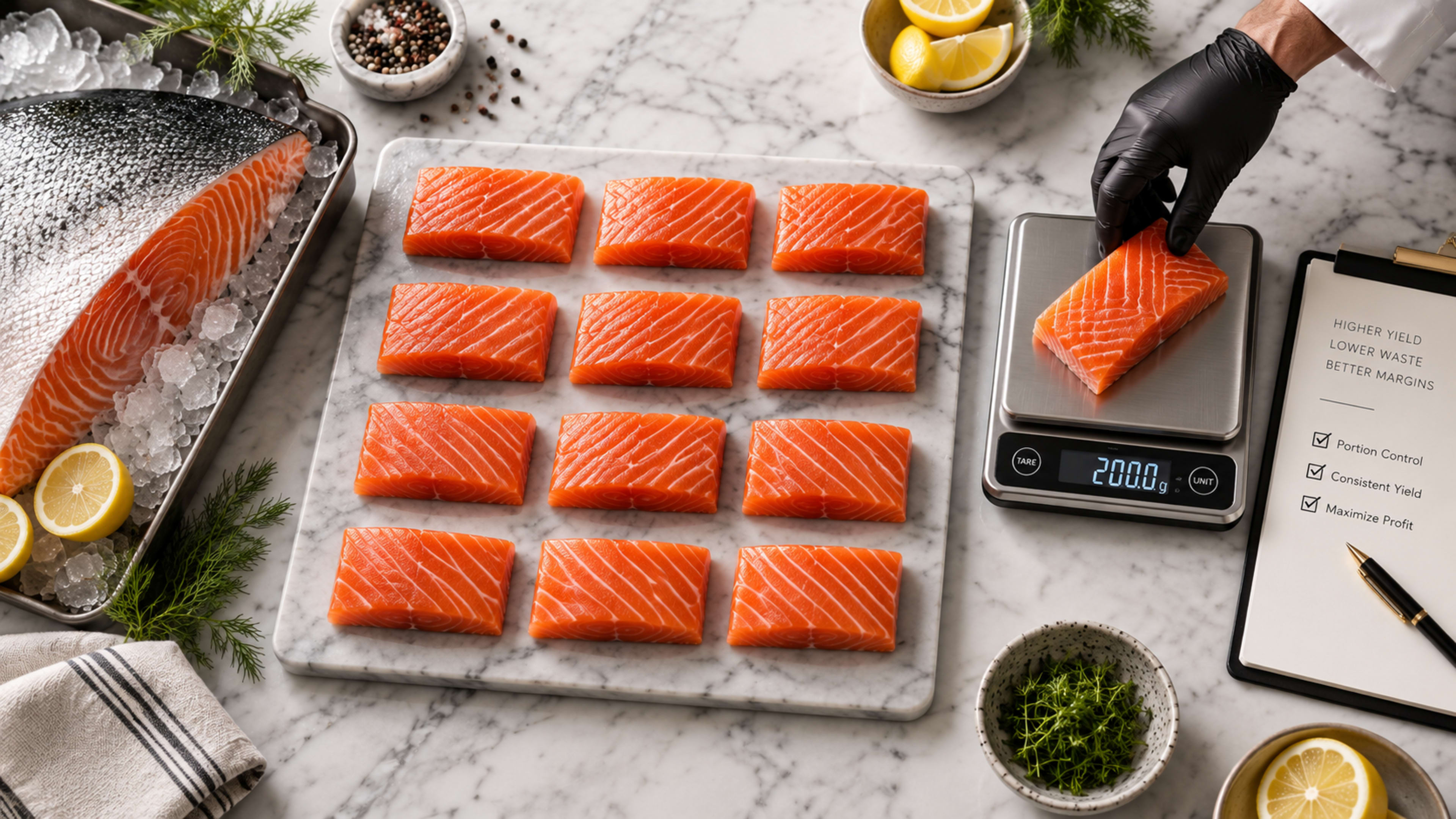
Some of it needs additional trimming. Portions do not come out as evenly as expected. Prep takes longer. More product is needed to produce the number of plates the menu was costed around.
The invoice has not changed, but the real cost has.
For professional kitchens, that difference is yield.
And when seafood is being served across hundreds of covers, multiple outlets, or an entire season, a relatively small difference in usable yield can matter more than a small saving on the purchase price.
Purchase Price Is Only the First Number
Procurement sees seafood in kilograms and unit prices. The kitchen sees usable portions. Those are not always the same thing.
A purchased kilogram only creates value in proportion to how much usable product remains after the preparation required for the dish, including trimming, portioning, and unavoidable waste.
That is why comparing two seafood products on purchase price alone can be misleading.
One product may carry a lower price per kilogram but require more work and produce less usable weight. Another may cost more when purchased but arrive closer to the format the kitchen needs, making portioning more predictable and reducing unnecessary trim.
For an F&B team, the more useful number is not simply cost per purchased kilogram. It is cost per usable kilogram and, ultimately, cost per plated portion.
A simple way to express that is:
Cost per usable kilogram = purchase price per kilogram ÷ yield rate
If a product delivers an 80% usable yield, the yield rate in that calculation is 0.80. In practical terms, every purchased kilogram produces 0.8 kilograms of usable product.
As the yield falls, the effective cost of every usable kilogram rises.
Yield Starts With Specification
Yield problems often begin before the product enters the kitchen. They begin with what was ordered.
Size, grading, cut, trim, preparation state, and portion format all influence how much work remains before seafood is ready for service.
Take salmon intended for a fixed plated portion. If the usable format or thickness varies significantly, the chef may have to change the way portions are cut to protect the plate standard. Some portions may become heavier than planned, while others require additional correction or trim.
Shrimp creates a similar issue. Its count and grading influence how many pieces are required per portion, how the dish presents, and how accurately the kitchen can predict the number of servings an order will produce.
Specification is therefore part of cost control, not simply product selection.
Food Box works with professional hospitality buyers on customised product specifications, order schedules, and volume requirements to match the way each operation works. Its core offer is built around premium frozen seafood solutions for professional kitchens.
Explore Food Box seafood solutionsLabor Belongs in the Cost Conversation
Yield is not only about weight. Time matters too.
A product that needs additional trimming, cleaning, sorting, or re-portioning creates labor that does not appear on the supplier invoice.
In a small restaurant, the difference may amount to several extra minutes during prep. In a large hotel, central kitchen, or catering operation, the same task repeated across substantial volume can consume significant staff time.
There is also an opportunity cost. During busy preparation periods, every unnecessary correction is time the kitchen team cannot spend on another task.
This is why the cheapest raw product is not automatically the most efficient product for the operation. The more work required to convert it into the product the recipe actually needs, the further its real operational cost moves from the number procurement originally approved.
Small Yield Differences Become Large at Scale
A few portions lost through unnecessary trim may appear insignificant in one delivery. Scale changes the picture.
A restaurant serving the same seafood dish throughout the week repeats that difference across every order. A hotel can multiply it across several outlets, banqueting, room service, and seasonal operations. A catering business may experience the entire effect in a single high-volume event.
Food Box supplies more than 200 hospitality partners in Egypt, including hotels, resorts, restaurants, and catering businesses.
At that level of hospitality activity, questions around product specification, volume planning, and repeatable performance become commercial issues rather than small kitchen details.
Learn more about Food Box’s B2B seafood supplyThe larger the operation, the more important it becomes to understand what every purchased kilogram actually produces.
Food Cost Is Not the Same as Buying Cheap
A dish is usually costed around an intended portion and a target ingredient cost. If the usable yield changes, the economics of that dish change with it.
The menu price may remain exactly the same. The guest still expects the same plate. The kitchen still has to produce it. The business absorbs the difference.
This is why experienced F&B teams look beyond purchase price when evaluating seafood. Preparation requirements, usable yield, portion control, product consistency, and availability can all influence the final food-cost result.
Food Box’s guide to wholesale fish suppliers looks at supply stability and large-volume purchasing from the procurement side.
Yield takes the calculation further by asking a different question: what does the product actually cost once the kitchen turns it into sellable portions?
What Procurement Should Ask Before Comparing Quotes
Two seafood quotes are only directly comparable when the products behind them are comparable. A lower number on a quote is not automatically a lower-cost product if the specification, preparation requirements, or usable yield are different.
Before comparing prices, procurement and kitchen teams should understand:
• What size or grading is being supplied?
• What preparation state and product specification are included in the quote?
• How much work remains before the product reaches its usable format?
• Does the format fit the portion the menu was designed around?
• Can the same specification be maintained across repeated orders?
These questions give procurement a more useful basis for comparison than price per kilogram alone. They also make the conversation with the kitchen more precise.
Instead of asking which supplier is cheaper, the business can ask which product produces the required portion at the right total operational cost.
The Right Format Depends on the Operation
There is no universal seafood format that produces the best commercial result for every kitchen.
A fine dining restaurant may place greater value on precise portions and presentation. A hotel buffet may prioritise formats that simplify preparation across high volume. A banqueting kitchen may need to produce hundreds of controlled portions within a fixed production schedule. A catering operation may need a product format that reduces preparation while still allowing accurate planning around a known guest count.
The right decision therefore begins with the operation and works backward to the product. This is where customised specifications become more useful than selecting seafood purely by category or price.
The same principle applies to Food Box’s catering and event supply, where bulk seafood requirements have to support weddings, corporate events, hospitality functions, and other high-volume service formats.
The Cheapest Kilogram Is Not Always the Cheapest Portion
Seafood purchasing becomes more commercially useful when the calculation continues beyond the invoice.
The question is not only what one kilogram costs when it enters the property. It is how much usable product comes out of it. How much preparation does it require? How accurately can the kitchen portion it? How many plates can the order realistically produce? And what does each of those finished portions actually cost?
That is where yield stops being a technical kitchen detail and becomes a commercial metric.
For professional kitchens, the strongest purchasing decision is rarely defined by the lowest number on a supplier quote. It is defined by the product that delivers the right usable value once preparation begins.
If your hotel, restaurant, or catering operation is reviewing seafood specifications, portion requirements, or volume needs, Food Box’s team can discuss available seafood solutions, product specifications, volumes, and delivery requirements.