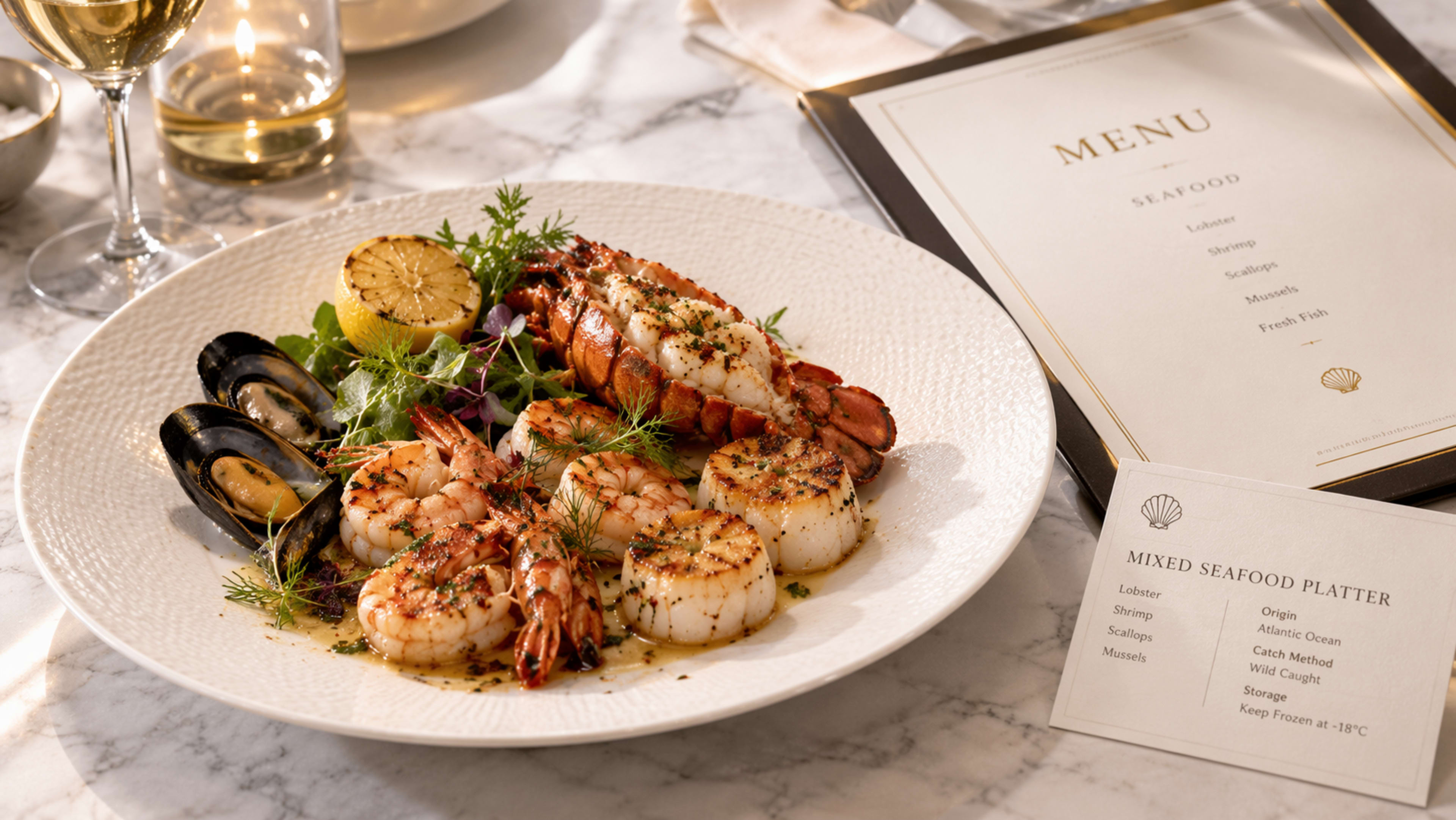
A hotel restaurant is preparing to introduce a new lobster main course. The chef imagines a whole lobster presented with its claws, while procurement receives a quotation for frozen lobster tails.
Both products belong to the wider lobster category, but they are not necessarily interchangeable.
The product in the quotation may come from a spiny lobster, an animal with a different anatomy from the clawed lobster the chef had in mind. That difference reaches beyond appearance. It determines which edible parts are available, how the product can be presented, and whether the kitchen can reproduce the intended dish.
For professional hospitality buyers, understanding the distinction between spiny and clawed lobster is an important step in identifying exactly what a menu requires.
Not Every Lobster Has Claws
One of the most recognisable differences between lobster types is their anatomy.
Clawed lobsters, including the American lobster (Homarus americanus) and European lobster (Homarus gammarus), have prominent claws on their front pair of legs.
Spiny lobsters, commonly associated with genera such as Panulirus and Palinurus, do not have those large front claws. They are characterised by a spiny body and prominent antennae.
These are distinct groups of marine crustaceans, even though both are commonly described as lobster in commercial and culinary settings. According to NOAA Fisheries, American and spiny lobsters can be distinguished by their claws and other anatomical characteristics.
For procurement, this is more than biological information. A kitchen requesting a whole lobster with large claws is describing a different product requirement from one requesting a spiny lobster tail. If that distinction is not communicated clearly, a quotation may appear suitable while describing an ingredient that cannot deliver the presentation the chef intended.
The Difference at a Glance
Large front claws — Clawed lobster: present. Spiny lobster: absent.
Recognisable examples — Clawed lobster: American and European lobster. Spiny lobster: Caribbean and other spiny lobster species.
Edible portions — Clawed lobster: tail, claws, and other edible meat. Spiny lobster: primarily tail and other edible body portions.
Common culinary presentations — Clawed lobster: whole lobster, claw meat, tail dishes. Spiny lobster: grilled tails, split tails, lobster meat preparations.
Key buying consideration — Clawed lobster: species, claws, product format, and preparation state. Spiny lobster: species, tail format, size, and preparation state.
These distinctions describe common characteristics, not universal product specifications. The exact commercial form depends on the species, processing method, and supplier.
Clawed Lobster: When the Whole Animal Is Part of the Experience
A whole clawed lobster has a recognisable role in premium dining. The claws are part of the presentation, and the edible meat inside them can contribute to the dish. For a restaurant serving whole lobster, this creates an experience that depends on the animal’s complete form.
The kitchen may present the lobster whole or use its different edible portions in a more composed preparation. Claw meat can also be relevant to dishes where distinct pieces of lobster are part of the intended presentation.
However, the presence of claws does not automatically make clawed lobster the better option for every menu. A restaurant serving only grilled lobster tail may have little use for a whole-lobster format if the remaining portions do not fit its production plan.
The important consideration is how the kitchen intends to use the product. If the claws form an essential part of the dish, procurement needs to identify a lobster species and purchasing format that can support that requirement. The decision should begin with the culinary application rather than the general prestige associated with lobster.
Spiny Lobster: A Different Product for Tail-Focused Dishes
Spiny lobster is widely associated with tail-based seafood preparations. Unlike clawed lobster, it does not provide the large claw portions found in species such as American lobster. That makes its commercial use particularly relevant to dishes designed around the tail.
A restaurant might feature a split lobster tail as a grilled main course, with the shell contributing to the finished presentation. Another operation may use lobster tail meat as part of a composed seafood dish. These applications do not necessarily require a whole clawed lobster.
However, the term spiny lobster does not identify one single species. Different species may be marketed under the broader category, and their available sizes, forms, and geographic origins can vary.
For professional buyers, that means a quotation for spiny lobster should still establish which product is being offered. A general description such as “premium lobster tail” may be sufficient for an initial conversation, but it does not provide every detail needed to confirm a menu requirement. The correct species, size, processing state, and available format should be clarified before the kitchen builds its purchasing plan around the offer.
Does One Type Taste Better Than the Other?
It can be tempting to describe one lobster type as sweeter, firmer, or more premium than another. However, those descriptions can oversimplify the differences.
Lobster eating quality depends on several factors, including the species, product condition, handling, processing, and preparation. A comparison between a frozen spiny lobster tail and a freshly cooked clawed lobster, for example, would involve more than a difference in anatomy. The handling and cooking conditions would also be different.
For professional kitchens, it is more useful to assess the actual seafood product quality of the specific product being considered rather than assume that an entire lobster category has one consistent flavour or texture.
A chef developing a menu may test a particular product under the restaurant’s intended preparation method. The result of that trial can inform the purchasing decision. But it should not be treated as proof that every product from the same lobster group will behave identically.
The appropriate question is not which lobster type is universally better. It is which available product delivers the characteristics required by the dish.
Lobster Tails Are Not All the Same Purchasing Proposition
A quotation described as lobster tail still requires clarification. The tail may come from a clawed lobster or a spiny lobster, depending on the product and market. It may be supplied raw or cooked, frozen in shell, split, or prepared in another form. These differences can affect the kitchen’s preparation process.
For example, a raw frozen tail intended for grilling requires a different cooking approach from a fully cooked product intended for reheating or incorporation into another preparation.
The quoted weight also needs to be understood. A shell-on lobster tail has a different weight basis from an equivalent quantity of extracted lobster meat. Those distinctions should be established before procurement compares quotations or the chef approves a particular portion.
Food Box’s existing guide to seafood specifications explains the broader purchasing principle: product names need to be supported by clear requirements for the format and characteristics the kitchen expects. For lobster purchasing, identifying the species or lobster group is an additional way of making that requirement more precise.
Species Identification Matters When the Menu Makes a Specific Claim
A restaurant may describe a dish simply as grilled lobster tail. Another may identify a particular lobster type or geographic origin as part of the menu description. The second creates a more specific expectation.
If the restaurant names American lobster, for example, the product information should support that identification. A spiny lobster should not be presented under a species-specific description that refers to a different animal.
The US Food and Drug Administration maintains The Seafood List, which connects scientific names with acceptable commercial and common names used in the United States. The reference illustrates why species identification can matter in seafood trade. However, US naming guidance is not a substitute for Egyptian product-labelling requirements or local commercial terminology.
For hotels and restaurants operating in Egypt, the practical principle remains straightforward: the name used to describe a seafood product should accurately represent what is being purchased and served. This is particularly important when procurement changes a product because of availability or another commercial consideration. A different lobster species may work successfully in the kitchen, but the restaurant needs to determine whether the change affects the description promised to guests.
Test the Product That Will Actually Be Served
A lobster product can appear commercially attractive on a supplier quotation without having been tested in the kitchen’s intended application.
For a grilled lobster-tail main course, the chef may need to assess the available size range, cooking behaviour, finished presentation, and practical preparation requirements. For a whole-lobster dish, the evaluation may place greater importance on the complete form and the edible portions required by the recipe.
Testing should use the actual product format the operation intends to purchase. A successful trial using one species, size, or processing state should not automatically be applied to a different product. The kitchen also needs to follow product-specific storage, thawing, and preparation instructions.
For professional kitchens, an effective trial connects accurate product identification with performance under realistic preparation conditions. That gives procurement more useful information than simply comparing products under the general heading of lobster.
Where Food Box Fits into Lobster Purchasing
Lobster is one of the core categories in Food Box’s seafood range, alongside shrimp, salmon, and scallops. The company supplies premium frozen seafood to professional hospitality buyers in Egypt, including hotels, resorts, restaurants, and catering businesses.
Food Box positions its offering around consistent quality, reliable supply, and product requirements suited to professional kitchens.
For lobster purchasing, the first conversation should establish the type of product the kitchen needs. A restaurant planning a whole-lobster presentation may have different requirements from a hotel developing a grilled lobster-tail dish. Those requirements can involve the species or product group, preparation format, size, order volume, and delivery arrangement.
Food Box’s public website identifies lobster as a core category but does not confirm every species or format currently available. It would therefore be inaccurate to assume the company supplies both clawed and spiny lobster, or every presentation discussed in this article. The appropriate approach is to confirm current availability and product specifications directly with the team.
Choose the Lobster That Matches the Dish
Return to the hotel restaurant preparing its new lobster main course. If the chef’s intended presentation depends on a whole lobster with prominent claws, procurement needs to identify a product capable of delivering that result. If the menu is designed around a grilled tail, a different lobster type or purchasing format may be appropriate.
Neither decision can be made accurately from the word lobster alone. Before confirming an order, culinary and procurement teams should be able to answer five questions:
• Is the intended product a clawed lobster, a spiny lobster, or a specifically identified species?
• Does the menu require a whole animal, tail, claw meat, or another edible portion?
• What product form, size, and processing state will actually be supplied?
• Does the kitchen’s intended preparation method suit that product?
• Can the supplier confirm the required product information, volume, and availability?
Those answers help translate the chef’s original idea into a purchasing requirement that can be evaluated accurately.
The best lobster is not automatically the one with the largest claws, the most impressive tail, or the highest price. It is the product that delivers what the menu actually needs.
For hotels, restaurants, and catering operations evaluating lobster requirements, Food Box’s team can discuss currently available products, specifications, volumes, and delivery arrangements.